What do 5W30, 5W40 and 0W20 mean? Oil viscosity, ACEA specs and approvals, explained
You open the bonnet, look at the bottle and find hieroglyphics: 5W-30, ACEA C3, VW 504.00/507.00, API SP, Low SAPS… What does it all mean? Is 5W-30 the same as 5W-40? Can I use 0W-20 if my car takes 5W-30? We get asked this every day in the workshop, and the short answer is: viscosity is only half the story. Two oils with the same “5W-30” on the label can be chemically opposite, and one of them can damage your particulate filter or your timing belt. In this guide we explain everything, from the basics to the technical side, the way we’d explain it to a customer on the other side of the glass.
2
numbers: cold and hot
100 °C
reference for the 2nd number
150 °C
HTHS film test
3
things to check: grade, spec, approval
What oil viscosity is (explained without formulas)
Viscosity is a liquid’s resistance to flow. Honey is very viscous; water barely at all. In an engine, oil has to do two contradictory things: be thin enough to reach every part within seconds when you start from cold, and “thick” enough to keep a film separating metal from metal when the engine is at 100 °C and spinning at thousands of revs.
All oil gets thinner as it heats up. Oil at 0 °C can be dozens of times thicker than the same oil at 100 °C. The chemists’ challenge is to keep that change as small as possible: not too thick when cold, not too thin when hot. That stability is called the viscosity index, and it’s one of the things that separates a good oil from a mediocre one.
Workshop fact
The most delicate moment for an engine is a cold start: for the first few seconds, until the oil reaches the top, parts run with very little lubrication. That’s why the oil’s first number matters more than it seems, even in Málaga.
What does 5W-30 mean? Why oil has two numbers
An oil like 5W-30 is a multigrade: it behaves like a thin oil when cold and a thicker one when hot. In the old days there were single-grade oils (SAE 30, SAE 40) and you had to switch between winter and summer. Today, thanks to synthetic base oils and polymers called viscosity index improvers, one oil covers the whole year.
The first number with the W (5W) describes cold behaviour. The W stands for Winter, not “weight” as people often say. The lower the number, the better it flows on a cold start: 0W flows better than 5W, and 5W better than 10W.
The second number (30) describes viscosity at operating temperature, measured at 100 °C. The higher it is, the thicker the hot oil film: a 40 is thicker than a 30, and a 30 thicker than a 20. These grades aren’t each brand’s opinion: they’re defined by the international SAE J300 standard, with lab-measured ranges.

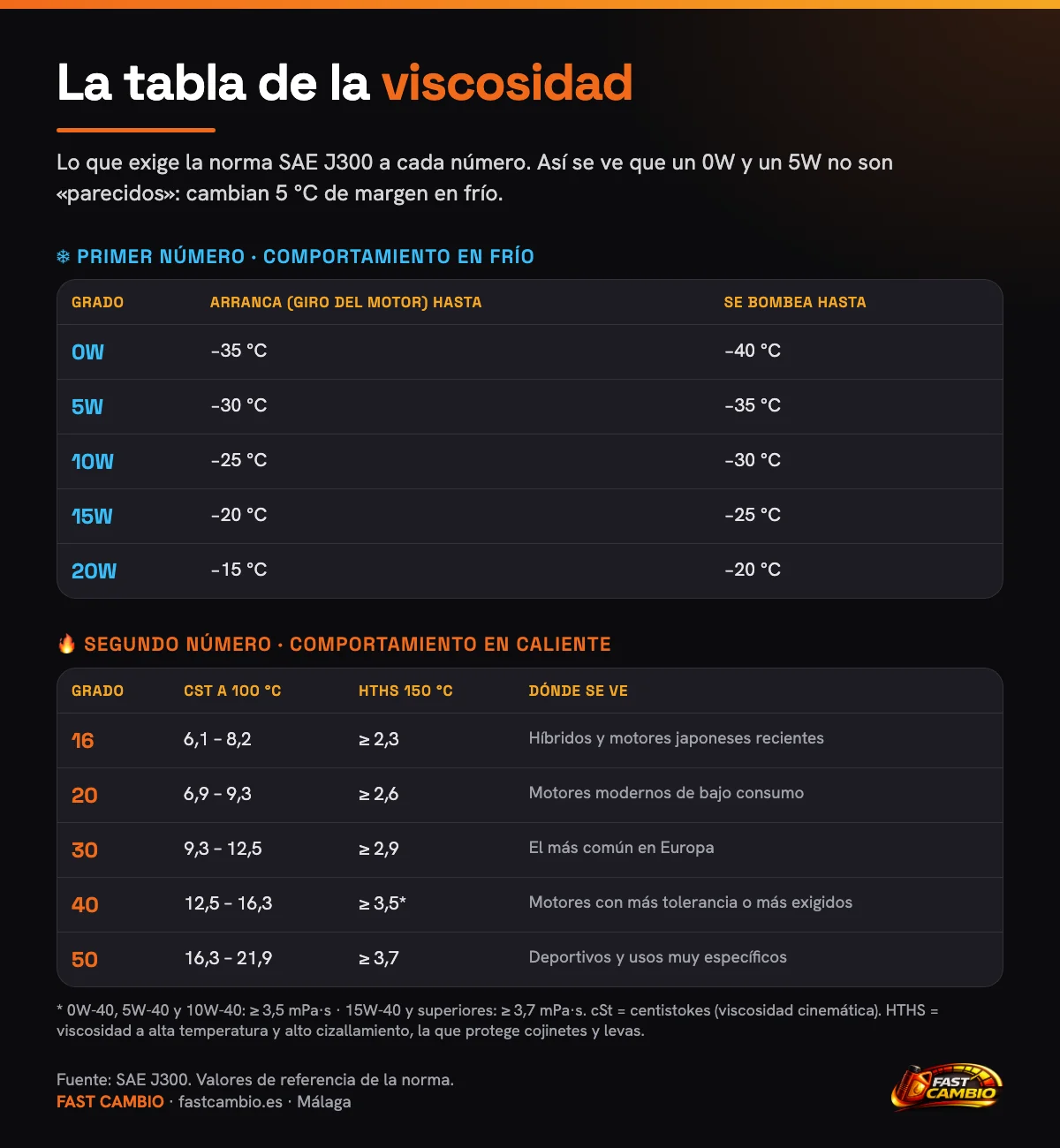
The SAE J300 table: what each grade requires
To be called “5W”, an oil has to let the engine crank at −30 °C and be pumped at −35 °C. To be called “30”, it has to measure between 9.3 and 12.5 centistokes (cSt) at 100 °C. And there’s a third, less known but crucial figure: HTHS.
| Grade | cSt at 100 °C | Minimum HTHS at 150 °C | Typical use |
|---|---|---|---|
| xW-16 | 6.1 – 8.2 | 2.3 mPa·s | Hybrids and recent Japanese engines |
| xW-20 | 6.9 – 9.3 | 2.6 mPa·s | Modern low-consumption engines (0W-20) |
| xW-30 | 9.3 – 12.5 | 2.9 mPa·s | The most common in European cars |
| xW-40 | 12.5 – 16.3 | 3.5 mPa·s (0W/5W/10W) | Older or highly stressed engines |
| xW-50 | 16.3 – 21.9 | 3.7 mPa·s | Sports cars and very specific uses |
HTHS (High Temperature High Shear) measures viscosity at 150 °C under enormous shear, which is what really happens in crankshaft bearings, on the cams or in the turbo. It’s the number that tells you whether the oil film holds when the engine is working hard. Note something important: two 5W-30s can have different HTHS (2.9 or 3.5), and that’s exactly what separates, for example, an ACEA C2 oil from a C3.
0W-20, 5W-30, 5W-40: real differences between the best sellers
| Viscosity | Cold | Hot | Which engines | Watch out for |
|---|---|---|---|---|
| 0W-20 | Maximum flow | Thin film (≥ 2.6) | Recent low-consumption engines, hybrids, VW 508.00, BMW LL-17 FE+, many Toyota and Honda | Not for engines designed for high-HTHS 5W-30 or 5W-40 |
| 0W-30 | Maximum flow | Medium | Many Peugeot/Citroën/Opel PureTech, Volvo, some BMW and Mercedes | There are 0W-30 C2 and 0W-30 C3: not interchangeable |
| 5W-30 | Very good | Medium (2.9 – 3.5+) | The European standard: VW 504/507, Renault, Stellantis, Ford, Opel, BMW, Mercedes | Depending on the spec (C2, C3, C4, A5/B5) it’s a different oil |
| 5W-40 | Very good | High (≥ 3.5) | Somewhat older petrol and diesel, VW 502.00/505.00, MB 229.5, hard-working engines | Many 5W-40s are Full SAPS: bad for a particulate filter |
| 10W-40 | Normal | High | Old cars, often semi-synthetic | Worse cold start; almost never what a modern car calls for |
5W-30 or 5W-40, which is better? Neither is “better” in the abstract. 5W-40 doesn’t protect more just because it’s thicker: a modern engine is built with very tight clearances and oil passages designed for a specific viscosity. Oil thicker than intended takes longer to reach the top on start-up, creates more friction (more fuel) and can confuse systems like variable valve timing that run on oil pressure. Conversely, oil thinner than intended may not hold the film in an engine designed for high HTHS.
Difference between 0W-20 and 5W-30? 0W-20 flows better when cold and forms a thinner film when hot. It cuts friction and fuel use, which is why recent engines and hybrids use it, since they start and stop the combustion engine hundreds of times per trip. But it only works properly in engines designed for it: if your engine calls for a 5W-30 to VW 504.00, putting in a 0W-20 to VW 508.00 isn’t an “upgrade”, it’s a mistake (and the reverse is too).
Myth: “It’s hot in Málaga, use a 40”
The engine runs at its temperature thanks to the thermostat, whether it’s 15 °C or 40 °C outside. That’s precisely why the second number is measured at 100 °C. What really punishes oil in Málaga isn’t summer heat: it’s short trips, Ronda and Puerto de la Torre traffic, air conditioning and daily cold starts. The answer isn’t a different viscosity: it’s respecting the spec and shortening the change interval.
Beyond viscosity: the additive package
An engine oil is a base (mineral, semi-synthetic or synthetic) plus an additive package that can make up a significant part of the bottle. That’s where the chemistry that truly protects your engine lives: detergents that prevent carbon build-up, dispersants that keep soot suspended so it leaves with the old oil, anti-wear agents (the famous ZDDP, based on zinc and phosphorus), antioxidants, friction modifiers and anti-foam agents.
The problem is that some of those additives, when tiny amounts burn inside the combustion chamber, leave ash. And that ash never burns off: it gets trapped in diesel particulate filters (DPF) and petrol catalytic converters. That’s why carmakers began to demand lower-ash oils, and the SAPS concept was born.
What SAPS means: Full, Mid and Low SAPS
SAPS stands for Sulphated Ash, Phosphorus and Sulphur. A Full SAPS oil carries the “full” anti-wear package (ash up to ~1.6%), very protective but harmful to a DPF. A Mid SAPS oil (ash ≤ 0.8%) is the balance most European cars use today. A Low SAPS oil (ash ≤ 0.5%) gives maximum protection to the exhaust after-treatment.
This explains one of the most expensive mistakes we see: a modern diesel with a particulate filter filled with Full SAPS 5W-40 “because it’s good oil”. The oil may be good, but not for that car: the ash slowly clogs the DPF, regenerations stop working and it ends in a repair costing hundreds or thousands of euros. If you want to understand that filter, we cover it in our article on the Motul Pre-ITV Kit and DPF cleaning.
We see it every day: same 5W-40, two different oils
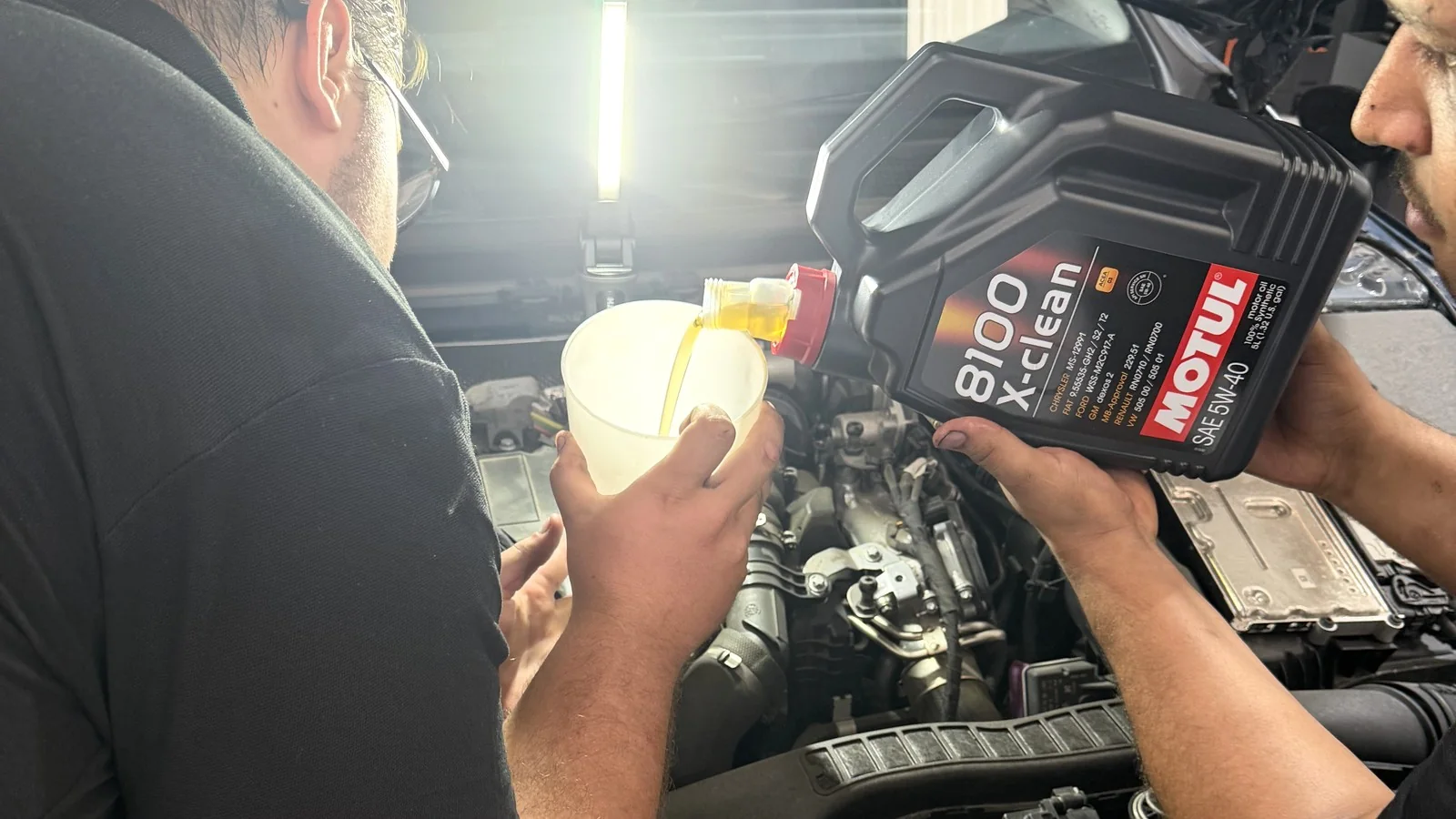
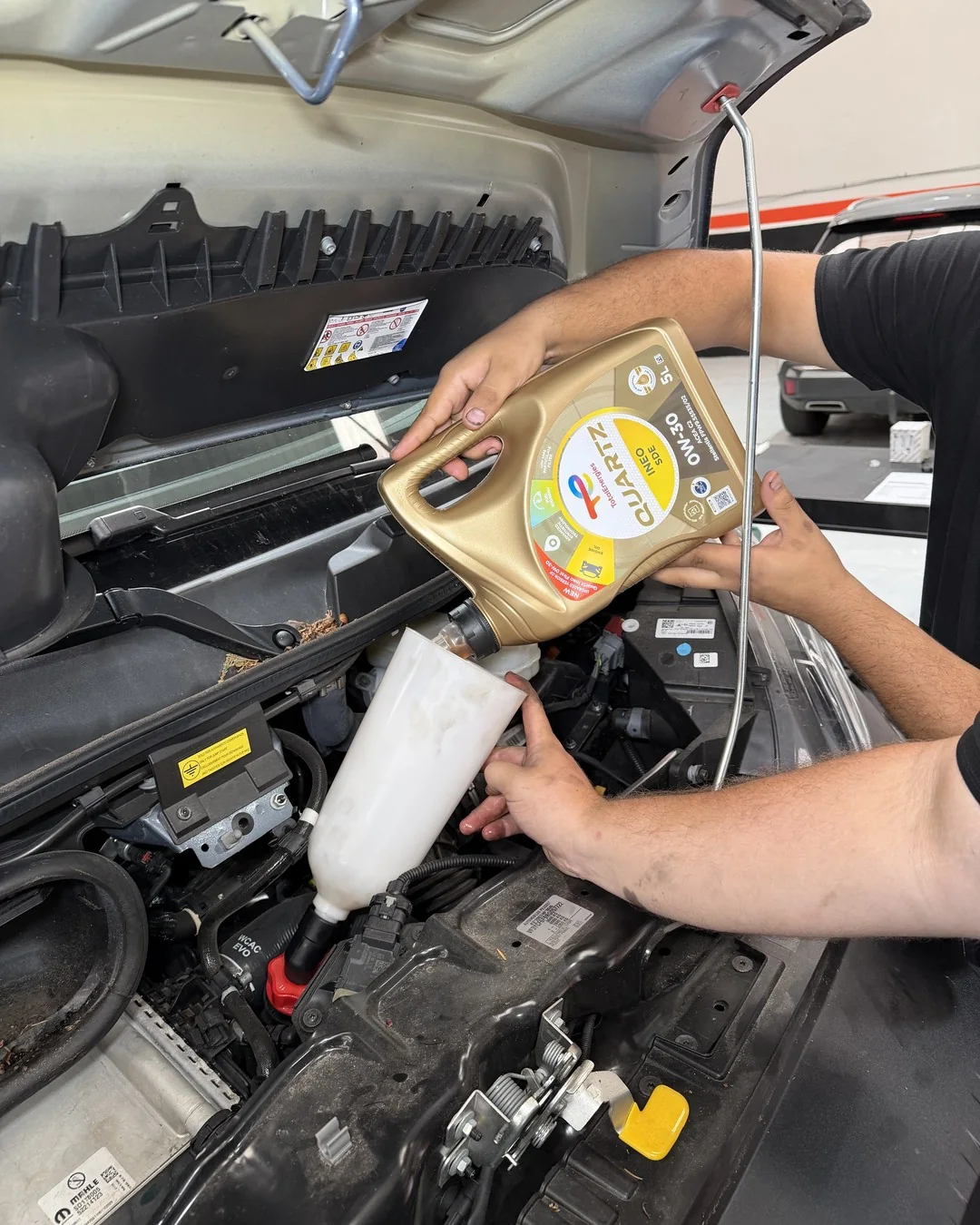
On our shelf there are two Motul bottles with the same viscosity, 5W-40, and they’re not interchangeable. 8100 X-cess is ACEA A3/B4, Full SAPS, for petrol and diesel without a particulate filter (VW 502.00/505.00, MB 229.5). 8100 X-clean — the one in the cover photo, in a Mercedes — is ACEA C3, Mid SAPS, DPF-safe (MB 229.51, VW 505.01). If you only look at “5W-40”, you can get it wrong.
ACEA specs: A3/B4, A5/B5, C2, C3, C4, C5, C6… what each means
ACEA is the European car manufacturers’ association, and it defines test sequences an oil must pass in engines and in the lab. The letter indicates the engine type: A petrol, B light diesel (cars and vans) and C engines with a catalytic converter or particulate filter, i.e. “after-treatment compatible” oils. The number isn’t a ranking: C3 isn’t “better” than C2, it’s different.
| Spec | SAPS | HTHS | Where it’s used |
|---|---|---|---|
| A3/B4 | Full | ≥ 3.5 | Petrol and diesel without DPF, high performance (VW 502/505, MB 229.3/229.5) |
| A5/B5 | Full | 2.9 – 3.5 | Fuel economy; Ford (WSS-M2C913) and others, only if the carmaker allows it |
| A7/B7 | Full | 2.9 – 3.5 | Turbo direct-injection petrol, with LSPI protection |
| C1 | Low | ≥ 2.9 | Some older DPF diesels; now almost obsolete |
| C2 | Mid | ≥ 2.9 | Peugeot, Citroën, DS, Fiat (PSA B71 2290, Fiat 9.55535) |
| C3 | Mid | ≥ 3.5 | VW Group (504/507), BMW LL-04, Mercedes 229.51/229.52, Opel dexos2: the most widespread |
| C4 | Low | ≥ 3.5 | Renault diesel with particulate filter (RN0720), some Mercedes |
| C5 | Mid | ≥ 2.6 | Modern low-consumption engines (0W-20, 0W-30) |
| C6 | Mid | ≥ 2.6 | Like C5 plus LSPI protection for modern turbo petrol |
Now you can see why “5W-30” isn’t enough: a 5W-30 C2 has HTHS ≥ 2.9 and a 5W-30 C3 has HTHS ≥ 3.5. A 5W-30 A5/B5 is Full SAPS. A 5W-30 C4 is Low SAPS. Four oils with the same viscosity on the label and four different chemistries. And the B1 you hear about? The old A1/B1 was a fuel-economy category for some Ford and Renault models that ACEA withdrew in 2016; today its role is covered by A5/B5 and the low-viscosity C specs.

And the API spec (SN, SP)?
API is the American standard. The latest for petrol is API SP, which adds protection against LSPI and timing-chain wear. On European cars, ACEA rules and, above all, the carmaker’s approval; API is supplementary. If you see “API CF”, it refers to diesel engines and usually comes with oils for older vehicles.
Carmaker approvals: VW 504.00/507.00, RN17, B71 2290, MB 229.51, BMW LL-04…
Above ACEA sits the carmaker approval: Volkswagen, Renault, Stellantis, Mercedes, BMW or Ford’s own standard, which requires extra tests on their engines. It’s the reference in your service book and the one that counts for warranty. These are the ones we see most in the workshop:
| Brand | Approval | What it means |
|---|---|---|
| VW · Audi · Seat · Skoda | 502.00 / 505.00 | Petrol and diesel without DPF (usually 5W-40) |
| VW · Audi · Seat · Skoda | 505.01 | Pump-injector (PD) TDI, very demanding on anti-wear |
| VW · Audi · Seat · Skoda | 504.00 / 507.00 | LongLife III, C3-type 5W-30, with particulate filter |
| VW · Audi · Seat · Skoda | 508.00 / 509.00 | LongLife IV, 0W-20 for recent engines; not for older ones |
| Renault · Dacia | RN0700 / RN0710 | Petrol and diesel without DPF (replaced by RN17) |
| Renault · Dacia | RN0720 | Diesel with particulate filter, C4 Low SAPS type |
| Renault · Dacia | RN17 / RN17 FE | Current spec; FE = low viscosity (0W-20, 0W-30) |
| Peugeot · Citroën · DS · Opel | PSA B71 2290 | C2-type 5W-30, very common on HDi/BlueHDi diesels |
| Peugeot · Citroën · DS · Opel | PSA B71 2312 | PureTech petrol engines, with oil-bathed timing belt |
| Fiat · Alfa · Jeep | 9.55535-(letter/number) | Each suffix is a different spec: check the exact one |
| Mercedes-Benz | 229.5 / 229.51 / 229.52 / 229.71 | Full SAPS / Mid SAPS with DPF / modern diesel / 0W-20 |
| BMW · Mini | LL-01 / LL-04 / LL-17 FE+ | Petrol / with DPF (C3) / recent 0W-20 |
| Ford | WSS-M2C913-C/D · WSS-M2C948-B | General 5W-30 / 5W-20 for wet-belt EcoBoost |
| Opel · Chevrolet (GM) | dexos2 · dexos1 Gen3 | Diesel and petrol with DPF / turbo petrol with LSPI |
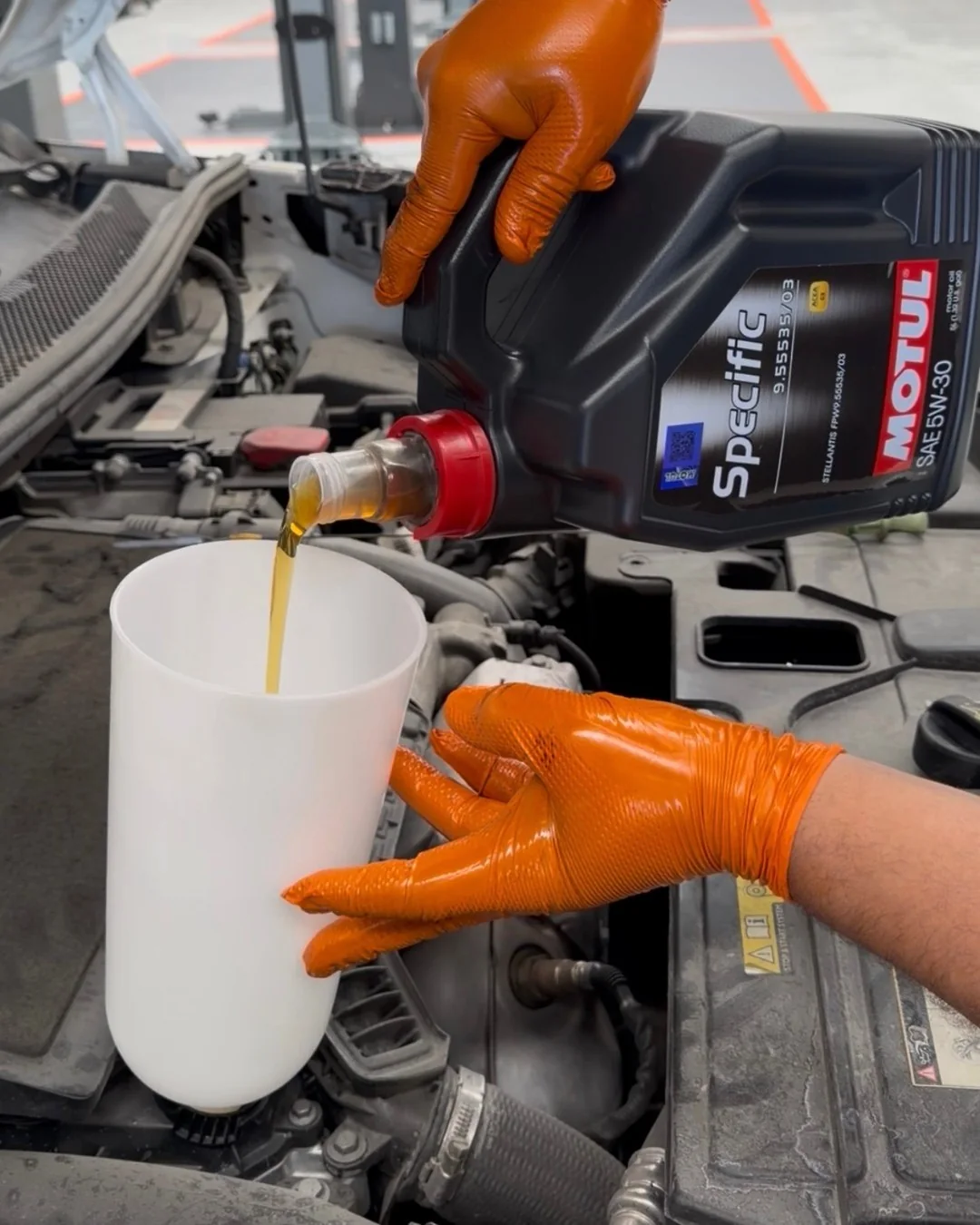
Watch out for a detail almost nobody reads: on the bottle, “Approved” isn’t the same as “Meets” / “Recommended for”. “Approved” means the carmaker has tested that oil and lists it officially. “Meets” means the oil brand declares it complies, but it hasn’t gone through official approval. For a car under warranty or a delicate engine, we always look for “Approved”.

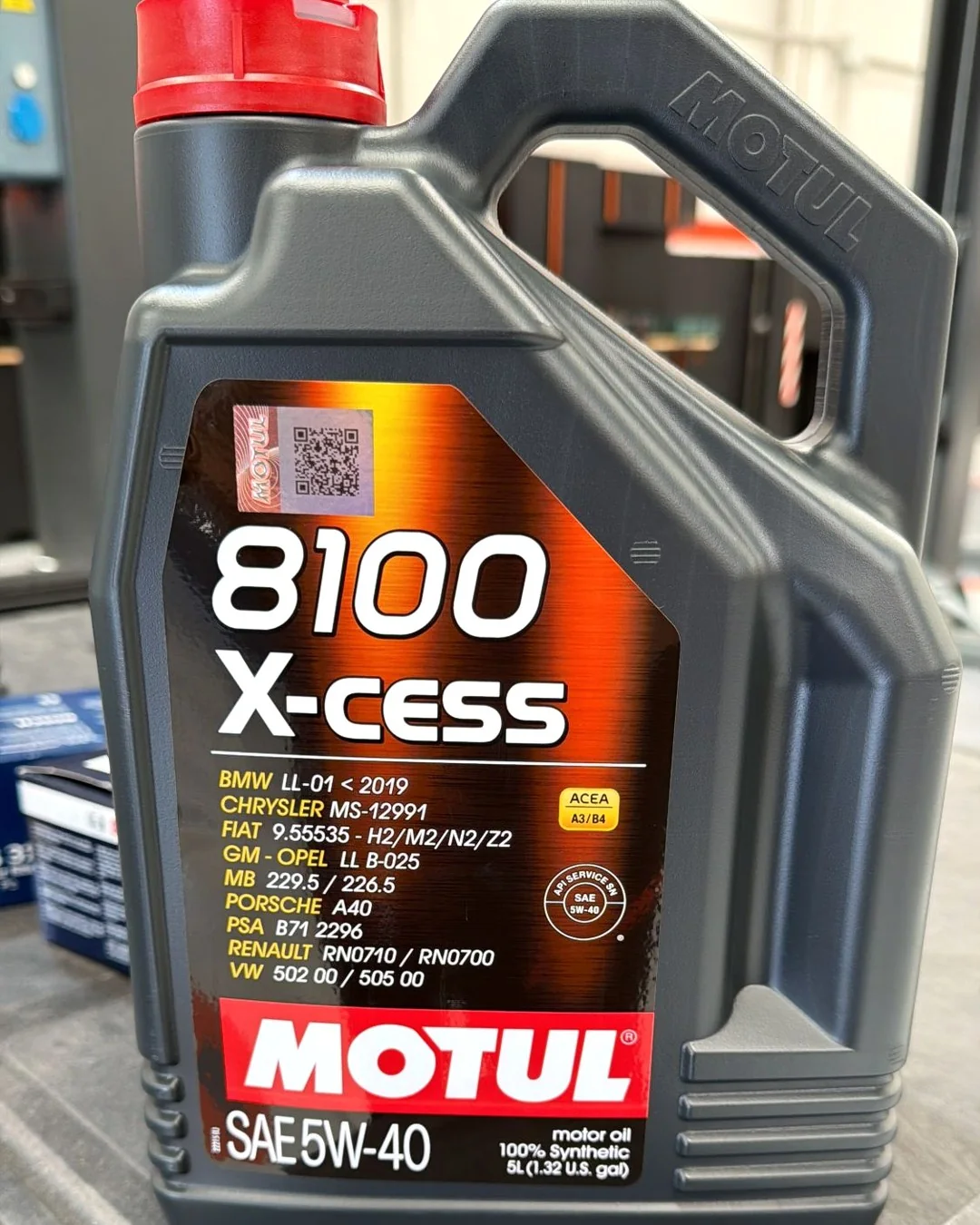
This is how to read a real bottle. On the one in the photo, the viscosity is 5W-40; the spec, ACEA A3/B4 (Full SAPS, HTHS ≥ 3.5) and API SN; and below, the list of approvals: VW 502 00/505 00, Mercedes 229.5, Renault RN0700/RN0710, PSA B71 2296, BMW LL-01… It’s an excellent oil for the engine that calls for exactly that, and the wrong oil for a modern diesel with a particulate filter that needs a C3 or C4.
Oil-bathed timing belt: here the exact oil is mandatory
Some very popular engines have the timing belt inside the engine, running immersed in oil (a “wet belt”). The best-known examples are the 1.0 and 1.2 PureTech in Peugeot, Citroën, DS and Opel, and Ford’s 1.0 EcoBoost. It’s a design that cuts noise and friction, but it has a weak point: the belt’s rubber is in permanent contact with the oil.
If the oil doesn’t have the formulation approved for that belt, if changes are stretched, or if the oil gets diluted with fuel (common on short trips), the rubber swells and degrades. It starts shedding small fragments that travel through the sump and end up clogging the oil pump’s pickup strainer. The result is a drop in oil pressure, the warning light and, at worst, serious engine damage. On PureTech engines, that debris can even affect the brake servo vacuum pump.

If your car has an oil-bathed belt
- Use only oil with the exact approval (PSA B71 2312 or whatever your book states; Ford WSS-M2C948-B or later)
- Don’t stretch changes: in the city, sooner rather than later
- Always change the oil filter with the oil
- Watch the oil pressure light and the level
- Have the belt inspected at the carmaker’s intervals
- Be wary of “this oil works for everything”
Engines with a timing chain also depend on oil: the chain is lubricated by it and its tensioner is hydraulic, fed by oil pressure. Degraded or soot-laden oil speeds up chain stretch, which shows up as a rattle on cold starts. Another reason not to stretch changes or skimp on oil.
LSPI: why modern turbo petrol engines need a special oil
Small, turbocharged, direct-injection petrol engines (the typical modern 1.0 or 1.2 turbo) can suffer LSPI (Low Speed Pre-Ignition): spontaneous detonation at low revs under heavy load, for example accelerating in a high gear. It can break pistons or conrods. Part of the problem lies in certain oil additives that encourage that self-ignition, which is why recent specs (API SP, ACEA C6 and A7/B7, GM dexos1 Gen3) include specific anti-LSPI tests. Another reason not to put “the usual oil” in a modern engine.
Synthetic, semi-synthetic or mineral oil: what changes
The oil’s base matters too. Mineral oil comes straight from crude refining: cheap, but less stable with temperature and quicker to degrade. Semi-synthetic blends mineral and synthetic bases. Synthetic uses highly refined or chemically built bases (hydrocracked, PAO, esters), with a high viscosity index, better cold starts and more resistance to oxidation.
In practice, almost every oil meeting modern specs (C2, C3, C5, 0W-20…) is synthetic, because mineral bases can’t meet those demands. So if you choose by spec and approval, the base is already sorted. What makes no sense is putting a semi-synthetic 10W-40 in a car that calls for a 5W-30 C3 just because it’s cheaper.
How to find out which oil your car takes
Service book
The official source: it states the approval (VW 504.00, RN17, B71 2290…) and the viscosities allowed for your engine and climate.
Identify the engine, not just the model
The same model can have engines needing different oils depending on year and version (petrol, diesel, with or without DPF, wet belt or chain).
Look it up by plate
At Fast Cambio we look up the exact spec by number plate in the oil makers’ technical catalogues and show it to you.
Check the bottle
Viscosity + spec + “Approved” approval. If all three match your engine, it’s the right oil; you choose the brand.
Before we open the bonnet we tell you which spec your car calls for, show you the bottle with that approval and you choose the brand: Motul, TotalEnergies, Liqui Moly… Fixed price before we start, and the work in plain sight.
The oil mistakes that cost the most money
What we see in the workshop
- Putting Full SAPS 5W-40 in a diesel with a particulate filter
- Choosing by viscosity alone (“it’s 5W-30, fine”) without checking the spec
- Putting 0W-20 in an engine that needs high HTHS (or the reverse)
- Generic oil in a wet-belt PureTech or EcoBoost
- Stretching changes to 30,000 km doing only city driving
- Topping up with “whatever was in the garage” to a different spec
And one more: thinking the oil’s colour tells you when to change it. In a diesel, oil turns black within a few kilometres because the dispersants are doing their job and keeping soot suspended; that doesn’t mean it’s worn out. And oil that looks clean can be degraded. The interval is decided by kilometres, time and type of use, as we explain in how often to change your car’s oil. And with the oil, always the oil filter.
Oil change in Málaga with the exact spec
At Fast Cambio, at Calle Ceramistas 13 (Málaga), an engine oil change starts with what you’ve just read: identifying the engine, checking which viscosity, ACEA spec and approval it requires, and showing you the bottle before we use it. If your car has a wet belt, a particulate filter or a latest-generation 0W-20, you’ll know before it goes on the lift. Book on WhatsApp with your number plate and we’ll tell you which oil it takes and the fixed price.
Key takeaways
- 5W-30: 5W is cold behaviour (W = Winter) and 30 is viscosity at 100 °C
- Viscosity alone isn’t enough: check the ACEA spec and the carmaker approval
- Same 5W-30, different chemistry: C2 (HTHS ≥ 2.9), C3 (≥ 3.5), C4 (Low SAPS), A5/B5 (Full SAPS)
- With a particulate filter: C oils (Mid or Low SAPS), never Full SAPS
- Wet belt (PureTech, EcoBoost): only the approved oil, and no stretched intervals
- On the bottle, “Approved” beats “Meets”
Frequently asked questions
What does the W in 5W-30 oil mean?
It stands for Winter. The number next to it describes how the oil behaves when cold: the lower, the better it flows on a cold start. Under SAE J300, a 5W allows cranking at −30 °C and pumping at −35 °C.
Can I use 5W-40 if my car takes 5W-30?
Only if your service book explicitly allows it and the oil carries the same approval. Many modern engines with particulate filters call for a 5W-30 C3 or C2, and many 5W-40s are Full SAPS: unsuitable. When in doubt, the carmaker’s spec rules.
Is 0W-20 better than 5W-30?
It’s neither better nor worse: it’s different. 0W-20 is for engines designed for that viscosity (hybrids, VW 508.00, BMW LL-17 FE+…). In an engine that needs a high-HTHS 5W-30, 0W-20 may not hold the oil film. Use what your engine calls for.
What’s the difference between ACEA C2 and C3?
Both are Mid SAPS and DPF-safe, but C3 requires a minimum HTHS of 3.5 mPa·s and C2 2.9. C2 is typical of Peugeot, Citroën and Fiat; C3 of the VW Group, BMW and Mercedes. They’re not interchangeable unless the carmaker says so.
Which oil does a PureTech engine take?
One with the approval stated in its book, usually PSA B71 2312 (or the newer Stellantis spec depending on the year), in the stated viscosity. Because its timing belt runs in oil, a non-approved oil can degrade it. We check it for you by number plate.
What does VW 504.00 / 507.00 mean?
It’s the Volkswagen Group LongLife III approval: 504.00 for petrol and 507.00 for diesel, usually as a C3-type 5W-30, DPF-safe. It replaces 502.00 and 505.00 in engines that call for it. Newer engines may require 508.00/509.00 (0W-20), which isn’t backward compatible.
Can I mix two oil brands when topping up?
Engine oils are miscible, so a one-off top-up is fine if it has the same viscosity and the same spec or approval. What you shouldn’t do is top up with oil to a different spec (for example, Full SAPS in a car with a DPF).
Is a thicker oil better for a high-mileage engine?
Not as a general rule. Going thicker may mask oil consumption, but it worsens start-up lubrication and doesn’t fix the cause. The sensible approach is to keep the carmaker’s spec and, if the engine burns oil, diagnose why.